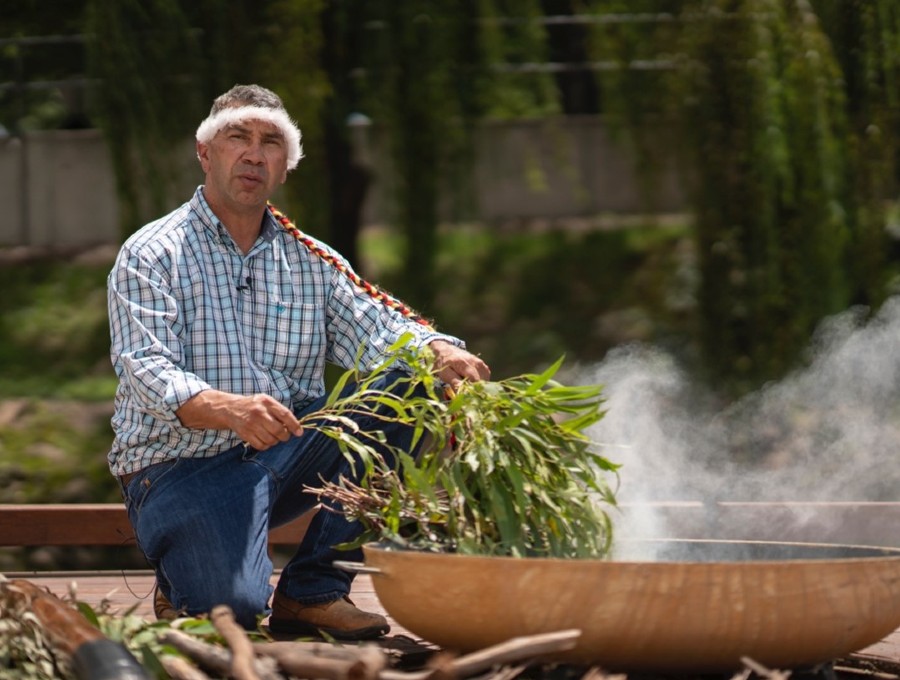
The red dirt of Gulkula on Gumatj Country has long been a place of intercultural dialogue, and the home of the annual Garma Festival.
This year’s festival theme “Bukmak” (Everyone), is a Yolŋu Matha expression of unity and a celebration of the diversity of modern Australia. Against this backdrop, a diverse delegation of women leading vital work across the multicultural sector arrived in Northeast Arnhem Land for The Garma Festival 2026.
Hosted by Reconciliation Australia alongside Gumatj Elder and former Reconciliation Australia Board Member Djapirri Mununggirritj, the delegation embarked on four days of learning, yarning, dance, song and truth-telling. Their presence signalled a shift in how Australia’s national story is written, turning a historically exclusive dialogue about reconciliation into a shared responsibility.
Changing the Conversation
For decades, the formal reconciliation movement operated largely as a bilateral conversation between Anglo-Celtic Australia and First Nations peoples. Reconciliation Australia Board Member Rana Hussain highlighted the necessity of broadening the dialogue to reflect the modern makeup of the nation.
‘Australia is a story of waves of migration after First Peoples’ ownership of the land,’ she told NITV when they visited the delegation.
‘So, I think we really need to come into a place where we have a conversation with all those different people from around the world as to what does it mean to be on this country.’
The shared cultural exchange prompted delegates to reflect on the shared experiences of racism faced by First Nations peoples and multicultural communities in Australia.
Nesreen Bottriell, CEO of the Australian Muslim Women’s Centre for Human Rights, stressed that any progress for migrant communities depends on dismantling the foundations of racism.
‘Addressing racism and discrimination that impacts Australian Muslim communities will only be achieved by confronting, challenging, and dismantling the structures that perpetuate racism against First Nations peoples,’ Bottriell stated.
During the political forums at Garma, Bottriell felt the lessons on self-determination resonated deeply.
‘I heard First Nations Elders and speakers talking about cultural safety and freedom of cultural expression, how systems built for rather than by First Nations communities consistently miss the mark, and conversely, how systems designed and led by community have achieved remarkable progress.’
Truths into Action
Thousands of multicultural migrants make Australia home each year, often arriving with little understanding of its colonial legacy. Yet, data reveals that these newer communities are emerging as powerful allies in the reconciliation movement.
The 2024 Australian Reconciliation Barometer reveals that the overwhelming majority of multicultural Australians (90 per cent) believe the relationship between First Nations peoples and non-Indigenous Australians is critically important.
A further 81 per cent believe in the importance of truth-telling at higher levels than Anglo-Australians, where support sits at just 67 per cent. Migrants are more than twice as likely to have participated in a local truth-telling activity than their Anglo-Celtic counterparts.
To foster this momentum, Reconciliation Australia translates information on National Reconciliation Week in 13 languages other than English to build a stronger connection with these multilingual communities.
While migrants often view settlement in Australia as a story of hope and future promise, communities increasingly recognise that for First Nations people, the term chronicles a history of displacement, violence and profound loss.
‘There is pain, of course, of colonisation and dispossession, but there is an absolute sense of a focus to the future, that we will heal,’ Violet Roumeliotis, CEO of Settlement Services International said.
‘And we do that through truth-telling, it’s a journey, we do it through maintaining our culture, and we do it through having a voice and taking control of our lives, and I feel that it’s such a very powerful way to go forward.’
A New Standard for Settlement
This groundswell of community momentum is transforming policy across the settlement sector.
The Settlement Council of Australia’s (SCOA) national roadmap, titled All In: A National Commitment to Reconciliation Across the Settlement Sector, introduces a standardised approach to help newly arrived families connect meaningfully with First Nations leadership from their very first day in the country.
It acknowledges that the language of ‘settlement’ has obscured the reality of invasion, dispossession and the erasure of First Nations cultures and communities.
It declares that confronting this truth is not an act of guilt but one of moral clarity and responsibility and commits to “a future in which settlement does not repeat the harms of colonisation but becomes a practice of reconciliation grounded in truth, sustained by respect and accountable to justice”.
SCOA’s inaugural Reconciliation Action Plan embeds these values into the very core of its work as a network of migrant service providers.
‘Garma does not end when we leave Gulkula. The real work begins as we return to our organisations, members and communities,’ SCOA CEO Maria Dimopoulos AM explained.
‘We have a responsibility to embed what we have learned across the settlement sector by strengthening partnerships with First Nations organisations, deepening accountability, and ensuring reconciliation is reflected not only in our words, but in our leadership, advocacy and everyday practice.’
For Bottriell, carrying this invitation back to her community is the enduring legacy of Garma.
‘Our work is only just beginning, and we came away with a commitment to carry on what we learned, to share widely and to be active allies, to strengthen our connections to First Nations and to continue to champion efforts towards reconciliation.’
This article is from the 56th edition of Reconciliation News. Read the rest of the issue.