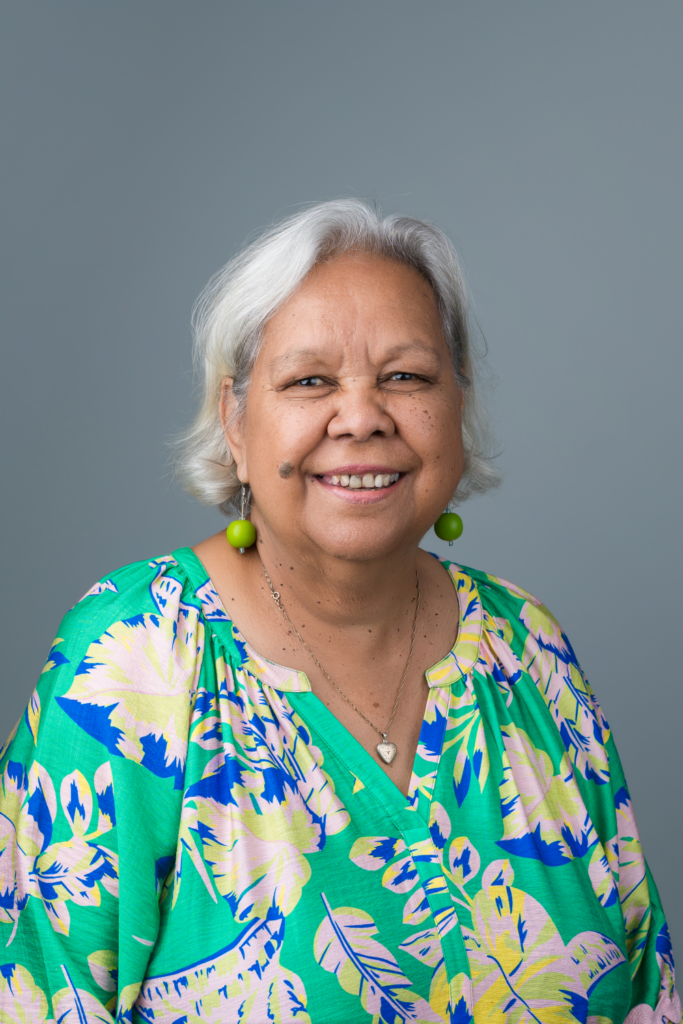
Dr Jackie Huggins AM FAHA has spent decades at the forefront of Australia’s reconciliation movement.
A Bidjara (Central Queensland) and Birri-Gubba Juru (North Queensland) woman, historian, author and lifelong advocate, Jackie was a member of the Council for Aboriginal Reconciliation and later served as Co-Chair of Reconciliation Australia. She was also a co-commissioner for the landmark Bringing Them Home inquiry and, more recently, co-chaired Queensland’s Path to Treaty process.
Looking back to 2001, when Reconciliation Australia was established, what stands out to you about that time?
There was such a sense of hope and expectation. We’d come off the momentum of Corroboree 2000 and the bridge walks, where hundreds of thousands of people showed up for reconciliation. We were riding a wave of great love and optimism.
Back then, there was no social media. We did the hard yards without it. That had its positives and negatives. We didn’t have the instant messaging or reach that exists now, but we built a genuine grassroots people’s movement. People gathered in kitchens, halls, meeting rooms and community spaces across the country. The Aboriginal grapevine spread the message far and wide.
We also didn’t yet know the term ‘allies’. People were simply supporters who stood with us. The vocabulary has changed over time, but reconciliation itself has not.
For me, reconciliation has always come down to three things: recognition, justice and healing. Those principles still encapsulate what reconciliation means.
You were working closely with leaders like Dr Evelyn Scott AC during that period. What did you learn from them?
Evelyn Scott was my great political mentor. I remember her saying to me one day, ‘Jackie, I hate doing media. You do it.’ It was one of those commands from an Elder that you don’t refuse.
Thankfully, I discovered I loved it. I’ve spent much of my life communicating these issues and trying to bring people along.
Another important mentor was Brian Aarons, our communications manager at the time. He gave me advice I’ve carried ever since: pick your battles and don’t become a mouthpiece for everything. That really strengthened me in how I approach public conversations.
Evelyn and Sir Gustav Nossal were both getting tired by then. They said to us younger ones, ‘We’re passing the baton to you now.’ It was one of the greatest privileges of my life to help carry that baton as Co-Chair of Reconciliation Australia.
Over the past 25 years, what changes have you witnessed, both positive and challenging?
We’ve seen major moments of progress. I was involved in the Bringing Them Home inquiry, we saw the National Apology, we saw growing support for reconciliation and stronger allyship across the country.
But many of the social indicators remain devastating. When we did the Bringing Them Home (1997) report, there were about 2,000 Aboriginal and Torres Strait Islander children in out-of-home care. Today it’s around 25,000.
Incarceration rates have also worsened. Aboriginal women are now among the most incarcerated populations in the world.
At the same time, there are areas that give me enormous hope. Education is one of them. I work at the University of Queensland and I see young people who are deeply grounded in culture and also excelling in fields like medicine, science and astrophysics.
What I love most is seeing young people using their education to benefit community while staying connected to culture first and foremost. That’s powerful.
You’ve been outspoken about the setbacks to treaty and truth-telling processes in Queensland. How are you feeling about the state of reconciliation right now?
I’m still grieving both the referendum and what happened with Queensland’s treaty process.
We spent years working towards treaty in Queensland. Then the first act of the new government was to shut that process down. That was heartbreaking.
But I never believed reconciliation was dead after the referendum. Over six million people voted yes. We cannot forget that. We need to keep bringing those people with us.
There’s also incredible truth-telling work happening at community level. Communities are continuing this work on their own terms in places like Cherbourg, Minjerribah and Cairns.
Truth-telling and treaty are connected. I often say truth-telling is the why and how, and treaty is the what. You cannot separate them.
What role do allies play in the next chapter of reconciliation?
I learnt the importance of allyship as a child during the 1967 referendum campaign. I followed my mother to meetings and saw Aboriginal and non-Aboriginal people working together.
Back then, some of the strongest allies came from the churches, the trade union movement and the Communist Party. Today, allyship is much broader and more visible.
I still believe deeply in people working together. Reconciliation has always been about relationships.
People don’t have to attend every rally or march. But they do need to keep showing up, listening, learning and standing alongside communities. That’s how reconciliation has endured over the past 25 years and why it will continue into the future.
One thing reconciliation has taught me is that you must be willing to talk with people you disagree with. You can actually change minds through relationships and conversation.
As Reconciliation Australia marks 25 years, what does being truly ‘All In’ for reconciliation look like to you today?
It means never giving up.
It means continuing to show up for each other and for communities experiencing injustice and racism. It means recognising that reconciliation belongs to all of us.
Over the past 25 years, reconciliation has become part of Australia’s shared vocabulary and consciousness. I still use the word in every speech I give because I never want it to disappear. Sometimes people say, ‘I don’t know if I’m doing reconciliation.’ But they are. If you are listening, learning, building relationships and standing up for justice, then you are part of it.
What keeps me going is my family, my friends, my networks and the young people coming through. Passing the baton to younger generations gives me enormous hope.
We’ve come a long way, but there is still a long road ahead. My motto has always been: never give up. We just keep trying to progress our people and our communities towards justice, parity and a better future for all of us.
25 Voices for 25 Years will be an ongoing series across our web and social channels that will highlight the work, impact and legacy of key voices in the reconciliation movement to mark 25 years of Reconciliation Australia.