First Nations peoples in Australia have contributed to significant changes within the education landscape over many decades, advocating for Aboriginal and Torres Strait Islander students to feel safe and supported in learning environments, and for all students to have the opportunity to engage in reconciliation and respect and recognise the world’s oldest continuous living cultures.
The formal education system in Australia has historically served as a tool of colonisation. Aboriginal and Torres Strait Islander peoples, pedagogies and historical perspectives have been systematically excluded from, and silenced within, mainstream education. As a result, generations of Australians have grown up with an inadequate understanding of First Nations cultures and perspectives and a very limited awareness of our shared histories.
Education institutions have contributed to a lack of historical acceptance; deepening inequalities and inequities; and limiting strong relationship-building and unification processes across generations.
Australia’s poor track record of including First Nations perspectives and historical truth-telling has caused damage to Australia’s social cohesion as non-Indigenous students have been denied a critical opportunity for learning and First Nations students have struggled with an arguably racist interpretation of our origin story, making learning environments an often hostile and unsafe place for them.
Noongar parent Kathleen Turtur has seen first-hand the impact of changes in the ways schools are now approaching First Nations cultures and perspectives. When her son, Reuben, started at Winterfold Primary School in Boorloo/ Perth, she immediately saw a change.
‘Now that culture and language are celebrated at his school, there is pride in our kids and when they are free to express this, they go in amazing directions’, said Kathleen. ‘Reuben was a quiet kid, but when he was introduced at school to culture, dance and language he came out of his shell; his confidence grew so much he was able to stand up in front of the whole school and do an Acknowledgement of Country.
‘He went from being a kid who was reticent about going to school to one who became enthusiastic about it.’
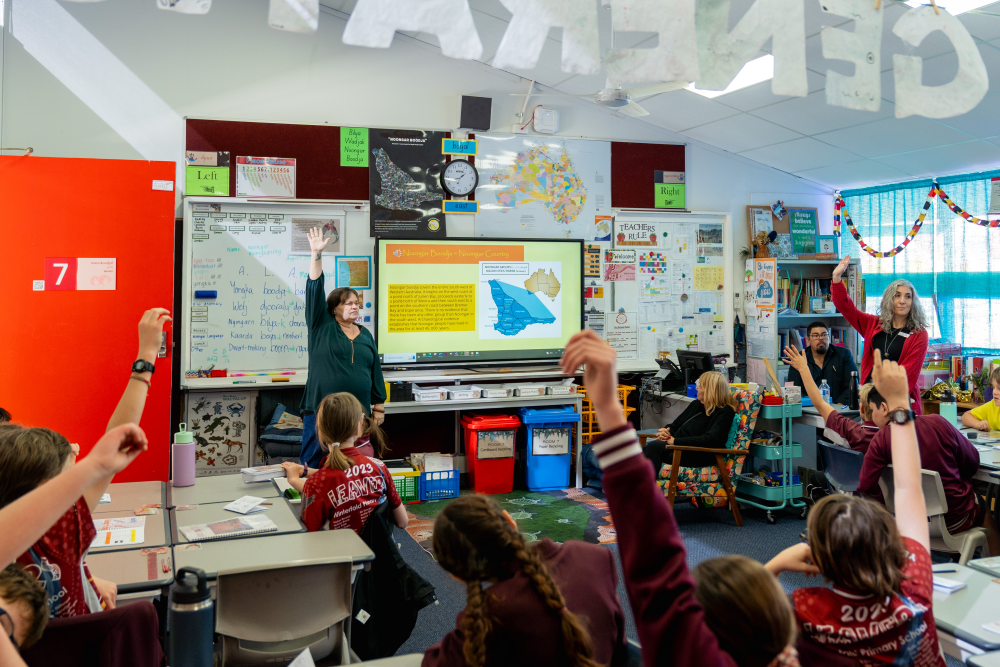
Australian classrooms are today undergoing a significant transformation, as Indigenous knowledge systems move from the margins to the core of what students learn. This shift, driven by sustained First Nations advocacy and shaped by reconciliation efforts, represents more than curriculum reform – it is a fundamental reimagining of what it means to be educated in Australia.
The changes are structural, not cosmetic. Rather than confining First Nations’ content to isolated units or special cultural days, the current Australian Curriculum weaves Aboriginal and Torres Strait Islander perspectives throughout every syllabus. Mathematics classes now explore the geometric principles in Central Desert dot paintings. Science students examine Indigenous taxonomy systems developed over 65,000 years. English courses integrate First Nations storytelling traditions.
These developments are also being reflected in early learning services through the Early Years Learning Framework with the 2024 Version 2 update strengthening Aboriginal and Torres Strait Islander perspectives throughout the framework’s vision, principles, practices and outcomes.
The changes in Australian education have been fueled by two significant declarations.
In 2008, the Melbourne Declaration on Educational Goals for Young Australians developed nationally consistent future directions for Australian schooling agreed by all Australian education ministers, including the need for students to “understand and acknowledge the value of Indigenous cultures and possess the knowledge, skills and understanding to contribute to, and benefit from, reconciliation between Indigenous and non-Indigenous Australians”. The Declaration led to an Australian Curriculum, which includes Aboriginal and Torres Strait Islander histories and cultures as one of three cross-curriculum priorities.
Then, in 2020, through the Mparntwe Education Declaration, Australian Governments re-committed to supporting all young Australians to “become confident and creative individuals, successful lifelong learners, and active and informed members of the community who… possess the knowledge, skills and understanding to contribute to, and benefit from, reconciliation between Aboriginal and Torres Strait Islander peoples and non-Indigenous Australians”.
Building Teacher Capability
Recognising that curriculum change alone is not enough, states are introducing mandatory cultural competency standards for teachers. Victoria is moving decisively, following the Yoorrook Justice Commission’s recommendations and subsequent Treaty, and will assess all teachers’ capacity to embed First Peoples’ knowledge, cultures and perspectives in learning effectively. School libraries face targets to audit and decolonise their collections by removing outdated or racist materials.
Professor Melitta Hogarth, head of the University of Melbourne’s Ngarrngga project, said these changes are significant beyond the classroom. ‘Education does not just impart information; it shapes who we are and who we might be,’ Hogarth explains. ‘Beginning in every classroom, education in Indigenous knowledge systems, histories and cultures is a nation-building exercise.’
Reconciliation Australia’s Role
Reconciliation Australia has been instrumental in bridging policy and practice through the first decade of the Narragunnawali: Reconciliation in Education program. Co-hosting national forums with academic partners, the program has helped shift the conversation from whether to include First Nations perspectives to how to do it meaningfully and respectfully.
This work emphasises that including First Nations knowledges benefits all students, not just First Nations children. As educators at the 2025 National Reconciliation in Education Forum noted, this inclusion shapes future citizens and builds a more complete understanding of Australian identity.
Looking Forward
These changes face implementation challenges. Schools and services need resources, educators require training and communities must navigate potentially difficult conversations about historical truths. Yet momentum appears unstoppable. With Victoria’s new curriculum launching in 2026 and other states watching closely, Australia is on the brink of reimagining education as a tool for reconciliation.
The transformation extends beyond adding content – it is about respecting First Nations’ knowledge systems as fundamental to Australian education. It is not about taking anything away from anyone, but rather it is about building a more complete, honest, and sophisticated understanding of what it means to live and learn on this continent.
For resources to support your school or service’s reconciliation journey, head over to reconciliation.org.au/narragunnawali
This article is from the 55th edition of Reconciliation News. Read the rest of the issue.