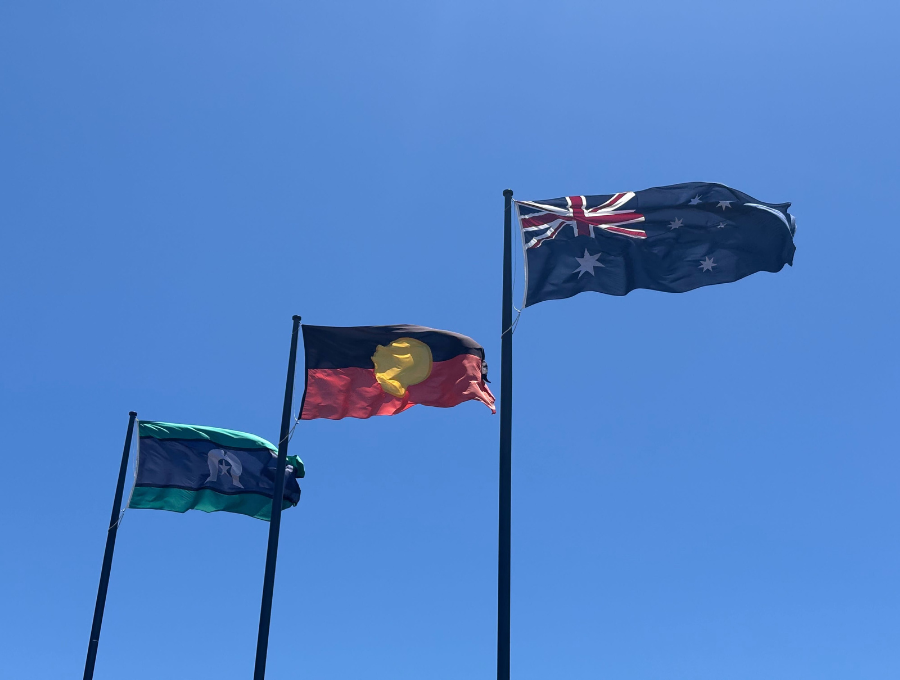
Australia has three official national flags: the Australian National Flag (the blue ensign), the Aboriginal Flag, and the Torres Strait Islander Flag.
Two different flags for distinct peoples
Aboriginal and Torres Strait Islander peoples represent two broad but distinct groups.
It is important to recognise that within each exists many equally distinct cultures, with their own traditions and languages. Some of these have their own flags, or adaptations of these flags.
Flying the Aboriginal and Torres Strait Islander flags demonstrates Australia’s recognition of First Nation peoples, promoting a sense of community partnership and a commitment toward reconciliation.
Each flag has a different history, and in 1995 both were recognised as official flags of Australia under Commonwealth legislation.
The Aboriginal flag
The Aboriginal Flag was designed by Harold Thomas, a Luritja man from Central Australia. According to Thomas, the meaning of the flag is represented through:
- Black: The Aboriginal peoples
- Yellow: The Sun – the giver of life and protector
- Red: The red earth – red ochre and a spiritual relationship to the land
The flag was first flown at Victoria Square in Adelaide on National Aborigines Day, 12 July 1971, after which it was chosen as the flag for the Aboriginal Tent Embassy in 1972.
The Torres Strait Islander flag
The Torres Strait Islander flag was designed by the late Bernard Namok of Thursday Island. The flag was recognised by the Aboriginal and Torres Strait Islander Commission in June 1992 and given equal prominence with the Aboriginal flag. The meaning of the Torres Strait Islander flag is represented through:
- Green: Land
- Blue: Sea
- White: Peace
- Black: The Torres Strait Islander peoples
At the centre of the Torres Strait Islander flag is a dhari (headdress) that represents the Torres Strait Islander peoples, and a five pointed star that represents the five major island groups, and the role of navigation in this sea-faring culture.
Displaying the flags
Flags should be flown and displayed in a dignified manner. This means that they should not be used as a curtain to unveil a monument or plaque, or used as table or seat covers. Flags should not be allowed to fall or lie upon the ground.
Flags should not be flown at night unless they are properly lit. Each flag should be flown from a separate flagpole.
Each flag flown should be the same size, and usually, flagpoles should be of an identical height. Tattered, torn, or dilapidated flags should not be flown, and may be destroyed privately.
It is important that the local community is consulted prior to the raising of Aboriginal and Torres Strait Islander flags. It is also important that flags are flown in an upright position. For the Aboriginal flag, this means that the black half is above the red. For the Torres Strait Islander flag, this means that the star is positioned below the dhari.
Both flags are of equal importance, and individual circumstances determine which flag, if not both, should be flown.
Display order
Where the Aboriginal and/or Torres Strait Islander flags are displayed alongside the Australian flag, the Australian flag takes precedence.
For more information, see the Department of Prime Minister and Cabinet Australian Flags booklet.
Copyright information
Permission is not required to fly either the Aboriginal or Torres Strait Islander flags but different rules apply for reproducing the flags on merchandise.
Aboriginal Flag reproduction
In 1997, the Federal Court of Australia found that Harold Thomas was the owner of the copyright in the design of the Aboriginal flag.
The Federal Government acquired the rights to the Aboriginal flag on behalf of the Commonwealth in an agreement with Harold Thomas in 2022.
With the copyright now with the Commonwealth, the Aboriginal flag is managed in a similar way to the Australian flag. It is free to be reproduced on clothes, stickers, for example, or in digital media, so long as it is reproduced in a respectful way.
For more information, visit the Department of Prime Minister & Cabinet website.
Torres Strait Islander Flag reproduction
The Torres Strait Islander flag copyright is held by the Torres Strait Island Regional Council.
The Council permits the reproduction of the Torres Strait Islander flag under these conditions:
- where appropriate, recognition is given to the original designer, the late Mr Bernard Namok
- the original PMS (Pantone Matching System) flag colours is used
- prior written permission is received from the Torres Strait Island Regional Council.
Buying flag products
As with any product associated with Aboriginal and or Torres Strait Islander cultures, Reconciliation Australia encourages the purchase of these products from Indigenous-owned businesses.
- Trading Blak supports Indigenous businesses selling clothes, jewellery, food and much more.
- Clothing the Gaps are an active First Nations social enterprise.
- Supply Nation has the largest directory of Indigenous-owned businesses in Australia.
Buying an Aboriginal or Torres Strait Islander flag
Flagworld is the authorised supplier of Aboriginal and Torres Strait Islands flags.